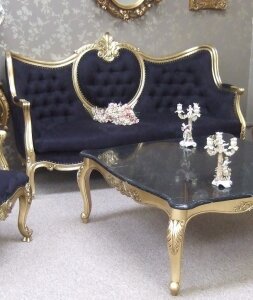
Louis XV Style
Louis the XV's reign covered from 1715 through 1774 and the style of the same name began in 1730 and was transformed into the Louis XVI Style in the 1760's
These three decades were truly fruitful in the development and style that is arguably the most brilliant, charming and so refined.
The main reason for this hive of creation was due to the golden age of that time, also known as the golden age of the Favorites Madame de pompadour, Madame du Barry and others. Not only were they royal mistresses, but also role models for the ladies of the time who took on the customs, fashions and decors of the period to their preferences.
Soon the grand suites of chilly ceremonial rooms in palaces were replaced by smaller ones that were well heated, comfortable and intimate.
The rooms in the new residences were smaller and more numerous, so we see a reversal from what was the norm. However they became for use- Specific and had several kinds of Salon salon de compagnie , Petit Salon , Salon de musique as well as a boudoir, Library, study and around 1740 a dining room
Above the main floor, each bedroom had its own dressing room, and boudoir (or intimate reception room)
As expected , every room was furnished with absolute attention to detail ,Objets d' art and exotic curiosities with an eye to the overall effect furniture was designed to give the most sumptuous comfort.
Such was the craze for this delicate style that an entire furniture industry emerged; worthy of the name .Specialists in luxury furniture, then passed this work onto subcontractors, who produced series that were sold by Specialist dealers.
Though never really given their due, they played an important role in offering advice to clients and producers, coordinating the work done by members of the various craft guilds, and therefore gave the style its unity.
A fusion with the literature of this time conspired to create an atmosphere of exceptional refined elegance and refined comfort. Without doubt Louis XV is the greatest of all periods for French Furniture. Furniture became practical and somewhat more readily available and easier to transport, without loosing any of its elegance.
Construction
Most solid wood furniture was made of Oak, or
Walnut.
That said, there are many examples of the use of Cherry, ash, chestnut and plum.
Beech and walnut were only used in chairs and other seating
Painted wood was often used as it gave harmony between the furniture and paneling; the mouldings and sculpture of both could be painted the same contrasting colour.
Marble was used to addcolour highlights to both furniture and interior decors . Thick overhanging tops honored the complex outlines of the pieces beneath them ; Generally , their moulded fore-edges were a quarter-round surmounted by a cavetto.
Rocaille and Rococo
Rocaille , was a late variant of the
Baroque that flourished in the Louis XV period , and spread rapidly throughout Europe. Due to its success designers were encouraged to take it to outrageous extremes . The result was the rococo, which in France almost always remains balanced, measured and elegant.
Seating
Daybeds, Armchairs, chairs and settees abounded . Their light and graceful forms by no means detracted from their comfort; and their carving. Intricate carvings abound and the seats became much softer due to la elastuque (Springs)
Made from hardwoods originally these would have been painted in several colours.
The most richly carved pieces were sometimes gilded. Towards the end of this period , pieces painted white became more fashionable.
Armchairs and Chairs
The Carving was detailed , and the chairs quality was recognized by its supple moldings, by the
harmonious curves of its legs, by the subtle relationships between its various parts.
Chair backs generally rose only to shoulder height, and exception was made for armchairs.
If a chair's back was flat, it was said to be a la reine; if slightly coved ,
it was en cabriolet
The sides if all backs from this period curve inward toward the centre (Violone) , if only slightly. Some examples of back designs are Rounded back (arrondi) , Bow Back (En arbalete) , back a double echancrure , Back a echancrure central ,
Floral Cresting and Rose Cresting
Seat rails were treated in many different ways , for example floret , cartouche and stylized scallop shell.
Chair Legs with gentle S Curves were decorated with acanthus and finished with scrolled feet and an acanthus leaf. Some examples are Floret , Flower and Scallop Shell.
The cabriolet armchair is one of the most common types , which featured a slightly coved back.
The bergere armchair is low and deep with in filled arms.